
My wife asked me to keep an eye out for tickets to a particular Carnegie Hall show. They were not on sale yet, and she wanted to know when they became available.
This is exactly the kind of small domestic job I do not want to keep in my head. I do not need an agent to be brilliant here. I need it to check a page once in a while and tap me on the shoulder when there is something worth looking at.
So I gave it the URL.
The agent hit an anti-bot wall.
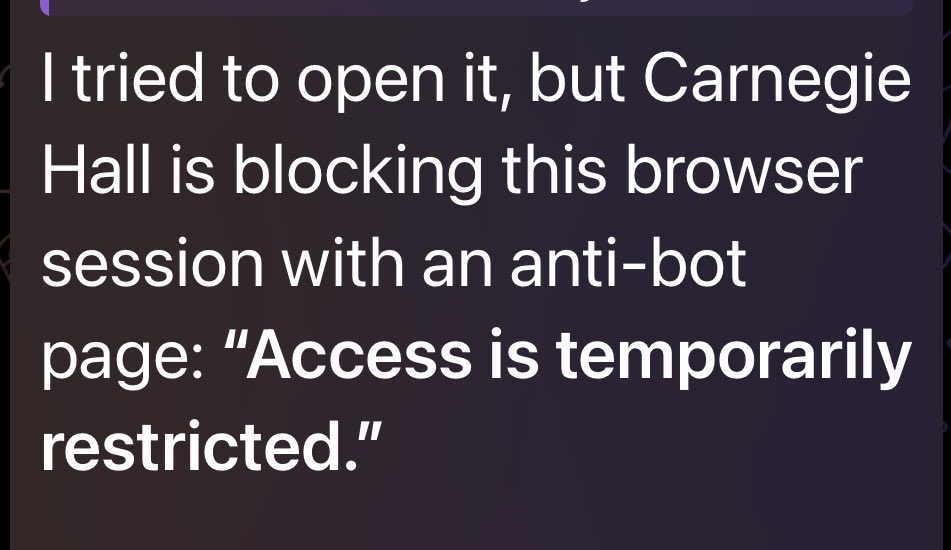
That was the whole job. Not scrape Carnegie Hall. Not train a model. Not copy their event database or hammer every performance on the calendar. Just keep an eye on one page so I did not have to.
If the tickets became available, the next step was probably buying them. Which is, I assume, something Carnegie Hall would like people to do.
My agent wasn’t trying to steal Carnegie Hall’s data. It was trying to help me buy Carnegie Hall tickets.
That is what makes this feel backwards to me. The agent was not replacing the customer. It was helping the customer show up at the right time.
We already have plenty of little helpers like this. Calendar reminders. Price alerts. RSS readers. Browser extensions. Tiny bits of automation that save us from staring at websites waiting for something to change.
Agents make that pattern more general. Instead of needing a purpose-built price alert or notify-me button, you can point an agent at the thing you care about and describe the outcome you want.
Of course sites are going to be wary of that. Ticketing is a horrible category for naive agent access. Scalpers automate availability checks and purchases. Fraudsters test accounts and payment methods. High-demand events can turn into a mess in seconds. My one harmless page check becomes a very different thing if thousands of agents start polling every minute. Queue systems exist because the abuse is real.
Carnegie Hall, or whatever security provider sits in front of that page, is not crazy to be defensive. If every agent gets to say “I am acting on behalf of a user,” every scalper gets to say it too. The answer is not “let the bots in.” That is too dumb.
But “bot” is becoming too blunt a category.
A training crawler, a search crawler, a commercial scraper, a scalper, a fraud bot, an accessibility tool, and a user-authorized purchasing agent are not doing the same job. Some are taking. Some are attacking. Some are helping a real person do something they were already going to do.
The web needs a way to tell the difference.
Cloudflare has been writing around this problem. They are not neutral here, obviously. They sell the machinery that sits in front of sites and makes these calls. But that is also why their framing is useful. Their Agent Readiness work says the web learned to speak to browsers, then search engines, and now needs to speak to agents. Their Signed Agents work talks about bots directed by individual users to plan trips, order food, and make purchases. In Moving past bots vs. humans, they make the more useful point: there are wanted bots and unwanted humans.
That is the distinction I wanted in this case. Not special treatment. Not a free pass. Just a way for the site to know this was a low-frequency check for a real person who was interested in buying a ticket.
For a ticketing page, maybe that means identified agents can do occasional read-only availability checks, but seat selection and payment still require human confirmation. Maybe the agent needs to be tied to an account. Maybe there are published rules for polling. Maybe high-demand shows say no agents at all for the first hour.
Fine. Make rules. Block bulk patterns. Block stealth crawlers. Block spoofed agents. I am not arguing for chaos with a nice prompt box on top.
I am arguing that a human manually refreshing Chrome should not be the only acceptable way for a customer to express interest.
We are going to ask agents to do more of this stuff: watch this page, tell me when this changes, find the appointment, compare these options, buy the thing if it matches the constraints I already gave you. Some of that should be blocked. Some of it should require confirmation. Some of it should be rate limited. Some of it should probably cost money.
But the customer is still the customer.
Sometimes they are clicking around themselves. Sometimes they are using a screen reader. Sometimes they are getting a calendar reminder. And sometimes they sent an agent ahead to watch the door.
As for the tickets, I’ll keep checking manually.
The robots lost this round.